AI Website Builders vs Custom Web Design in 2026: What Small Businesses Really Need
Written by Crunch Design Editorial
Expert insights on technology & custom code
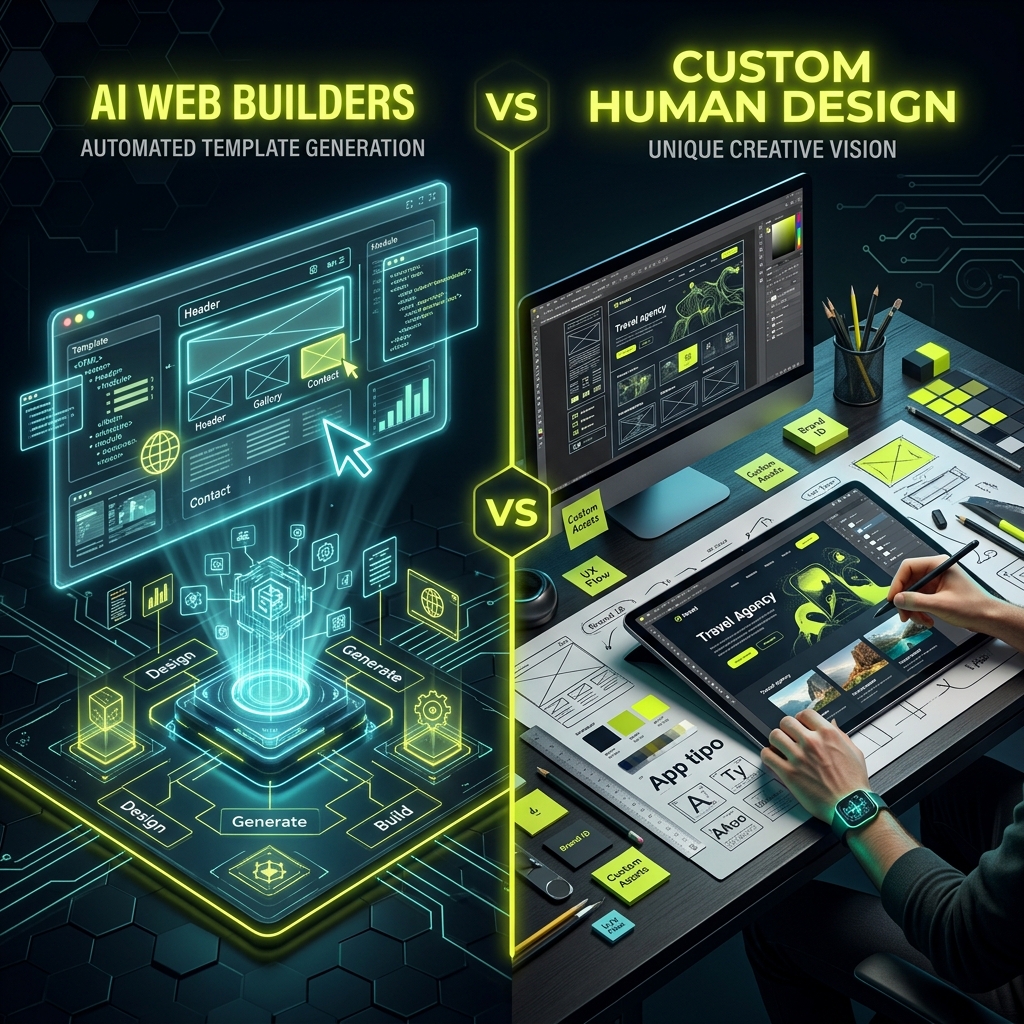
Every few months, there’s a new promise in the world of websites: Build your website in 30 seconds. Let AI write everything for you. Skip the designer. Skip the developer. Skip the cost. Skip the hassle.
And on the surface, it sounds brilliant. If you’re a small business owner, a startup founder, a restaurant owner, a local service provider, or anyone trying to grow online, AI website builders can feel like the answer you’ve been waiting for. They’re fast, accessible, and they make website creation look almost effortless.
But here’s the real question nobody asks loudly enough: If AI website builders are so good, why are so many businesses still ending up with websites that look okay, but don’t actually bring in enquiries, rank well on Google, or build real trust?
That’s the part worth talking about. Because in 2026, the question is no longer “Can AI build a website?” Of course it can. The real question is this: Can AI build the right website for your business? And that’s where things get interesting.
The new reality: getting a website online is easier than ever
A few years ago, getting a professional website built felt like a big project. You needed a designer, a developer, a strategy, a copywriter, someone to sort the hosting, someone to handle mobile responsiveness, someone to think about SEO, and someone to make it all look polished and credible.
Now, with an AI website builder, you answer a few questions, click a button, and a full website appears in front of you. For some businesses, that feels revolutionary. And to be fair, it is.
AI website builders have genuinely changed the industry. They’ve lowered the barrier to entry and made it easier for people to launch something quickly. If you need a temporary landing page, a simple personal site, or a quick first version of a business website, they can absolutely be useful.
But “useful” and “enough” are not the same thing. Because launching a website is one thing. Launching a website that actually helps your business grow is another.
Why so many AI-built websites still feel forgettable
Think about the last ten small business websites you visited. How many do you actually remember?
Most blur together. The same layouts. The same stock-style feel. The same safe wording. The same generic sections. The same “Welcome to our website, we provide quality services” energy. Nothing feels wrong exactly. But nothing feels sharp either.
And that’s the problem. A website should not just exist. It should do a job.
It should make someone trust you within seconds. It should make your business feel real, established, and worth contacting. It should guide the visitor clearly, showing personality, confidence, and professionalism. It should remove doubt.
A lot of AI website builders can produce a page. Very few can produce a website with real strategy behind it. That difference matters more than most businesses realise.
A website is not just design. It’s sales psychology, trust, structure, and clarity.
This is where small businesses often get caught out. They think they’re buying or building “a website”. What they actually need is a business tool. A good small business website is doing dozens of jobs at once:
- ✓Building trust in the first few seconds
- ✓Explaining what you do clearly
- ✓Making your service feel valuable
- ✓Answering unspoken customer questions
- ✓Removing friction before someone gets in touch
- ✓Showing proof that you’re legitimate and reliable
- ✓Helping Google understand your pages
- ✓Making it easy to enquire, call, book, or buy
- ✓Working properly on mobile
- ✓Creating a brand impression that people remember
That’s why custom website design for small businesses still matters so much. Not because it’s fashionable. Not because agencies want to make things sound complicated. But because your website sits right in the middle of how people judge your business.
In many cases, your website is your first salesperson, your first impression, your credibility check, and your conversion page all at once.
Looking for a custom business tool, not just a placeholder?
Let's build a custom Next.js digital platform engineered for speed, conversions, SEO, and visual excellence.
Build it with Crunch Design→The hidden problem with AI builders: they give you a site before they understand your business
This is the biggest issue. AI is brilliant at patterns. It can assemble layouts, generate copy, suggest sections, and speed up production.
But your business is not just a pattern.
Your business has a real audience, real objections, real competitors, real positioning, and real goals. A local driving school doesn’t need the same website strategy as a restaurant. A luxury interior brand doesn’t need the same website structure as an electrician. A startup trying to raise credibility doesn’t need the same messaging as a family-run local service business trying to get more phone calls.
And that’s exactly why custom web design still wins when results actually matter. A proper website should be built around questions like:
- •What is the customer worried about before contacting you?
- •What makes your business different from the other 10 options?
- •What should they see first on the homepage?
- •What pages actually matter for local and national SEO?
- •Where are people dropping off on your current pages?
- •What needs to be simplified to drive conversion?
- •What proof points are missing to build authority?
AI can help with output. But it usually doesn’t solve the thinking. And the thinking is the part that makes the website work.
So, are AI website builders bad?
No. Not at all. That’s the honest answer.
AI website builders are not the enemy. In fact, they’re useful tools. We’re in a stage of the industry where ignoring AI would be silly. It can speed up workflows, help with ideas, assist with content structure, and make the early stages of a website faster.
But relying on AI to replace strategy, positioning, conversion thinking, SEO planning, design judgement, and human decision-making is where businesses run into trouble.
The best approach in 2026 isn’t “AI or human”. It’s using AI intelligently, with human strategy and design direction behind it. That’s a completely different thing from pressing a button and hoping for the best.
The real cost of a cheap website is usually paid later
This is the part that catches people six months down the line. At first, the AI-built website feels like a win. It was quick. It was cheap. It looked decent enough. Everyone was happy.
Then the problems start appearing quietly:
- ✕The site doesn’t rank for critical search queries.
- ✕The copy feels vague and robotic.
- ✕The homepage is too generic to hook leads.
- ✕The service pages aren't structured properly for SEO or AEO.
- ✕The branding feels inconsistent and weak.
- ✕Customers visit, scroll a bit, and disappear without converting.
Eventually, you end up paying for a proper redesign anyway. Not because the first website “looked bad”. But because it didn’t do enough. And that’s the difference people miss all the time.
A website doesn’t fail only when it looks ugly. Sometimes it fails quietly by simply not helping the business grow.
What a custom website does that a generic AI site usually doesn’t
Let’s make this practical. A strong custom website design for a small business usually does a few things extremely well:
1. It creates a clear first impression
Your homepage should tell people who you are, what you do, who it’s for, and why they should care. Not in a robotic way. In a clear, human, confidence-building way.
2. It’s built around your actual customer journey
What does someone need to see before they trust you? What would make them hesitate? A custom website answers those questions before the visitor even asks them.
3. It reflects your brand properly
Colour, layout, typography, imagery, spacing, tone of voice, structure, and messaging all shape how professional your business feels. Custom design lets those decisions work together.
4. It gives you more control over SEO & AEO
If you want to show up on Google and AI engine answers, your page hierarchy, semantic code structure, headings, internal links, and content schema matter deeply.
5. It grows with your business
A good website should not feel outdated the moment your business evolves. You should be able to add pages, refine offers, and build on it without rebuilds from scratch.
So, do small businesses still need custom websites in 2026?
In many cases, yes, absolutely. Not because AI website builders are useless. Not because every business needs something huge or expensive. And not because “custom” automatically means better.
They need custom websites because most businesses are not struggling to have a website. They’re struggling to have a website that actually feels right, builds trust, and supports growth. That’s a very different problem.
A good website today is not just about being online. It’s about being convincing online. And when your website is often the first proper interaction someone has with your business, that matters more than ever.
Final thoughts
AI website builders have changed the web design industry, and they’re not going anywhere. They’ve made launching a site faster, easier, and more accessible than ever before. For some businesses, that’s genuinely useful.
But speed is not the same as strategy. A live website is not the same as an effective website. And a generated layout is not the same as a website designed around your business, your audience, and your goals.
If you want a website that simply fills a gap, AI might do the job. If you want a website that helps your business look better, feel more credible, rank more strategically, and convert more confidently, then thoughtful custom web design still matters. A lot. And in 2026, that’s probably the difference worth paying attention to.